News Article
Preview: The River
03 Jun 26
Director Janine Wunsche introduces her latest production. You may be familiar with Jez Butterworth’s other rowdy, fast-paced earlier plays such as Mojo and Jerusalem – this is a very different piece, as Janine explains.
Listen to Janine and actor Bre Henderson talk about the show with our friends on Spotlight at Riverside Radio (about 32 minutes in).
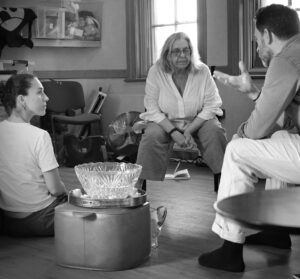
What drew you to directing The River?
Jez Butterworth is undoubtedly one of Britain’s best contemporary dramatists, having won numerous awards since his first play Mojo. His masterpiece, Jerusalem, played at the Royal Court, transferred to the West End and then to Broadway in New York.
The River, he claims, is his personal favourite.
The moment I started to read The River I was captured. The language is so poetic, and it feels charged with some kind of visceral, awakened awareness. I got to the final poem and just sat there, wondering what had happened to me. WOW! I had to explore it. I had no choice.
It flows like a river – with many layers. From playful frollics, to turbulent rapids, deep pools, still points, reflections, and powerful reveals, although it is a drama it unfolds in a rhythm which feels musical and transformative. It begins and ends with a poem by W.B Yeats –The Song Of The Wandering Aengus. This poem was inspired by an ancient Celtic myth. The River has a ritual quality, inviting us to explore some core human experiences which can be felt, but not fully understood.
It’s funny, tender, beautiful and mysterious. I had to dive in.
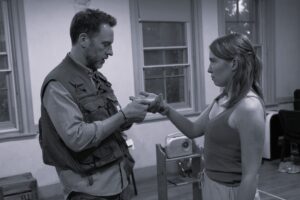
What have been the directing challenges for you? And the acting challenges for your cast?
I have never explored a piece like this before; The River is like water of course. It can slip through your fingers, be elusive, and surprise you. It keeps moving, as if it doesn’t want to be fixed. The possibilities are endless and you can never step into the same river twice. That’s exciting, but scary.
There is no linear plot as such, so we have explored more from a Felt Sense presence, moving from sequence to sequence. What is happening NOW? We had to let go of working it out from a reasonable, rational perspective. Resonance and emotional response have been more valuable.
As a director working on a play, I am never entirely sure where the rehearsals will take us, but I usually have a clear view of the overall storyline, which tells me what to aim for. Here, I just have to get into The River with the actors, follow threads and see where we end up. I have never had to work so much from a resonance and reflection perspective. At the same time, trying to grasp and keep hold of key moments or particular dynamics has been important. Anchors have proved valuable and necessary to our work, and the through line slowly emerged.
The drama is constructed in a fascinating and extraordinary form. It freely, and often suddenly, can shift from a sequence of surface witty banter to a deeply personal experiential reveal. The language shifts accordingly and becomes more poetic; it deepens into places that few dramatists reach. This has been an exciting challenge for the actors. allowing themselves to jump off psychological cliffs into exposing, profound vulnerable states. It is also really difficult to do. For an actor to open to themselves and each other in these places requires deep trust. I have had the honour to be working with some very good actors who are truly open, trusting, capable and willing. We all love The River.
It has felt more like a ‘surrender’ to The River; rather than an intellectual, rational working out of what to do, that surrender has been the better way in. We can now, at later stages of rehearsal, bring through our understanding. This approach has given us some fabulous rehearsal experiences and hopefully some insightful results.
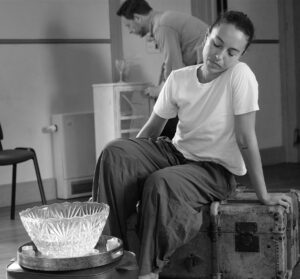
What themes does the play explore?
In the play script, on the page before the play begins, Jez Butterworth has included an excerpt from a T.S Eliot poem, Burnt Norton, from The Four Quartets. It says something which feels relevant to the drama, something about ‘consciousness’ .
“At the still point of the turning world. Neither flesh nor fleshless;
Neither from nor towards; at the still point, there the dance is,
But neither arrest nor movement. And do not call it fixity,
Where past and future are gathered. Neither from nor towards,
Neither ascent nor decline. Except for the point, the still point,
There would be no dance, and there is only the dance.”
The River explores potential and the nature of life, the many dances which emerge from the NOW in the ever evolving process of being. Time is not really linear in The River. Things happen regardless of it.
The poem which begins and ends the play, WB Yeats’ The Song Of The Wandering Aengus, is inspired by an ancient Celtic myth; so one of the themes The River explores is the relationship between myth and man.
It shows how people connect and disconnect in their quest for finding the right person to share love with. The funny twists and turns of getting to know someone; flirtation, banter, teasing, playing and challenging. How much to reveal, how trust is gained and lost. Can I say I love you?
A romantic weekend in a remote cabin in the woods. Will it lead to true love? On the surface The River is a recognisable, touching and funny tale. However, the search for the ideal partner to satisfy a deep yearning is precarious. Can anyone be ideal? Does anyone actually know what love is?
There are some profound, perhaps spiritual currents running through The River. The powerful force of nature is ever present.
The characters open to some ‘peak experiences’, enabling us to be reminded of our true nature and the interconnectedness of all there is. The River knows and sees everything. In its reflection we see ourselves.
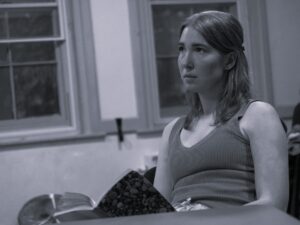
Tell us about the characters we'll meet
It’s interesting that Jez doesn’t name the characters. It seems relevant, making them less domestic. It is not easy to talk about them as we’re are given very little background information. They are:
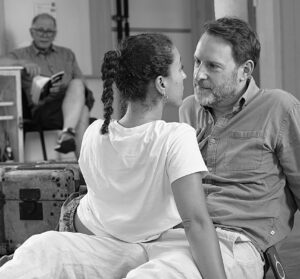
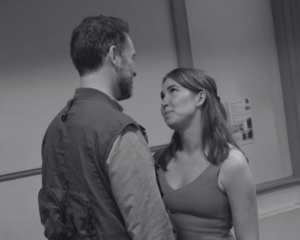
THE MAN (Ed Reeve) is in his 40s. He is passionate about fishing for sea trout, which migrate to the far north and return each year to spawn. This particular patch of river is very special to him. He seems to be a well-read historian and literary man, who connects with the poetry of Ted Hughes (who wrote a series of poems called The River.) He is single and looking for love.
THE WOMAN (Bre Henderson) is in her 30s, and in a new relationship with THE MAN. She has joined him for a romantic weekend. She enjoys reading, walking in nature and exploring the local sites. She had a dad who avoided being one. It seems she would like this quite new relationship to progress into something more.
THE OTHER WOMAN (Stella Talpo) is 30. A free spirit. Mysterious. Quite a chameleon.
Describe the play in three words
Funny. Touching, Awesome.
The River plays at SLT Fire Station 16 – 20 June 2026. Buy tickets here