News Article
Preview: They Promised Her the Moon
22 Oct 26
Director Craig Norman introduces his production which tells the true story of Jerrie Cobb, who should have become the first female astronaut, only to be denied her rightful place in the history of space travel.
Tell us about the true story behind the play
They Promised Her the Moon is based on the life of Geraldyn (Jerrie) Cobb, a remarkable American pilot who, while in her 20s, broke world records and won multiple awards.
In 1960, Jerrie Cobb took the same selection tests that were used to select NASA’s original seven astronauts, the “Mercury Seven”. At the time, no one knew whether the human body could survive in the weightless environment of space. The tests, devised by Dr William Randolph Lovelace, were particularly gruelling. What’s more, as testing and flying high-performance military jets was performed exclusively by men, there was very little biomedical data about how women would react to the physiological stresses of space flight. Not only did Cobb pass the tests, she matched the results of the Mercury astronauts, and even outperformed them in some instances.
Dr. Lovelace kept Cobb’s results secret until the 1960 International Symposium on Submarine and Space Medicine in Stockholm. There he publicly discussed her performance, and the possible role women might play in spaceflight; and then the world knew all about Jerrie Cobb. Life magazine seized on the story, and suddenly news outlets across the nation wanted a piece of the woman who was apparently poised to become the first female astronaut.
By the following year, twelve other women passed the Phase 1 tests. Cobb referred to the group as the First Lady Astronaut Trainees (FLATs); later they became known as the “Mercury 13”. But not everyone was enthusiastic about the idea of a woman in space. This was a time when the civil rights movement was still gathering momentum, and legislation regarding equal opportunities was yet to come.
Cobb was included in Life magazine’s list of the “100 Most Important Young People”. That Cobb was one of only nine women on the list was itself indicative of attitudes of the time. Media reports were often dismissive and patronising of her accomplishments. She endured many interviews where she was asked about her hair, clothes and favourite recipes, and frequently being asked: “Why does a pretty girl like you want to go into space?” Astronauts’ wives – perhaps protective of their husbands’ heroic images – talked of women “going along” on space missions, as if they would simply be passengers rather than being selected for their abilities to contribute to a mission. NASA’s official position was that women would go into space one day because secretaries and receptionists would be needed on a moon base. It was assumed that the norms of earthbound society at that time would extend into space. America was dazzled by the possibilities of the future but stuck in the prejudices of the past.
Days before the Mercury 13 were due to begin the final phase of testing, the programme was abruptly cancelled. NASA was not interested in including women in the space programme and refused to authorise the tests. In an attempt to force NASA’s hand, Jerrie Cobb and Jane Hart, another of the Mercury 13, testified at a Congressional hearing looking into the selection criteria for astronauts. Unofficially, the goal of the hearing was to investigate whether NASA was unduly discriminating against women: experience of flying military jets was required, which women were barred from doing at the time. The hearing was adjourned after two days with no resolution.
In 1963, the USSR sent Valentina Tereshkova into orbit, the first woman in space. It would be nearly two decades for the second woman and the first American woman to go into space.
Although the Mercury 13 were unsuccessful in becoming astronauts, there were positive outcomes. They helped redefine for society what women were able to do; Jane Hart channelled her anger at the outcome into becoming a founder member of the National Organization for Women (NOW), which spearheaded the equal rights movement later in the 1960s and 70s.
But for Jerrie Cobb, the result was a bitter blow. She had invested so much of herself into the testing and subsequent campaigning; friends said she was never the same afterwards. She withdrew from the public eye and devoted much of the rest of her life to flying humanitarian aid to remote communities in South America.
What drew you directing it?
I’m a space geek and can bore you rigid with endless trivia about the Apollo moon landings. While reading Jerrie Cobb’s Wikipedia page, I came across a reference to They Promised Her the Moon. Naturally, I was intrigued. As the play wasn’t yet available in this country, I tracked down a copy from the American publishers, and had it sent to my sister in upstate New York, where I was visiting later in the year.
When I read the play, even more than the subject matter, I was attracted to the theatrical style of the script. Scenes flowing from one to the next, jumping backwards and forwards in time, and in and out of reality. I relished the challenge of working with actors to tell a story that is not necessarily linear and conveying that story, in an entertaining way, to SLT audiences. I am also keen for others to learn about an extraordinary woman sidelined from history.
Tell us about the characters we'll meet, and their stories
Imagine floating in a light-proof, sound-proof tank where the air and the water are the same as your body temperature, deprived of all your senses. This is where we first meet Jerrie Cobb (Flora Blissett) as she undergoes one of the tests. As she floats, she relives her memories. We see her as an awkward 7year-old, a 12 year-old in love with flying, a headstrong teenager, and later a young woman determined to forge her own path as a pilot. Later in the play, she is suddenly thrust into the media spotlight before dealing with the frustration of being denied a chance to go into space.
Dr Randy Lovelace (Randy Brown) has been a pioneer of aviation medicine since WWII. He devised the astronaut selection tests, and now he is curious how women will respond to the tests. As NASA isn’t paying for the tests, he turns to his old friend, Jackie Cochran (Caroline R Doyle). Jackie is not only famous for having beaten a field of male pilots in a transcontinental air race, setting up a corps of women pilots during WWII and being the first woman to break the sound barrier, she also runs a successful cosmetics company and is married to a wealthy industrialist. This programme is the latest in a long line of projects supporting female pilots that has benefitted from Jackie Cochran’s money and connections. She was once described as wanting to open the door to women fliers, as long as she could be the first one through the door, and no one else was too close behind!
Helena (Alison Ryan) and Harvey (Andy Barrett) are Jerrie’s parents. Harvey gave Jerrie her first flying lessons and is her greatest supporter. As his dreams begin to unravel after the war, Jerrie’s successes keep him going. Helena has more traditional ideas of a woman’s role in the home and society, rooted in her deep faith. Jerrie has a close relationship with her father, but a much more difficult one with her mother.
Jack Ford (Joe Dominic) runs a company ferrying surplus military aircraft around the world. He prefers flying planes but also enjoys life when he is on the ground. Joe also plays John Glenn, the first American to orbit the Earth, returning to huge national adulation. After he left NASA, he entered politics, was elected to the US Senate where he served for 25 years, and even briefly and unsuccessfully, ran for President in 1984.
One of Jerrie’s earliest memories while she floats in the isolation tank is of her first grade teacher, Mrs White (Jemima Dunn) who is exasperated by Jerrie’s difficulties in communicating. Jemima also plays a young woman who sees Jerrie as a role model.
Congressman Anfuso (Ian Cuthbert) is a Congressman from New York. He chairs a public hearing looking into whether NASA’s astronaut selection criteria discriminates against women.
We will also come across schoolchildren, pilots, reporters, and lab technicians.
What have been the joys and challenges of directing a true story?
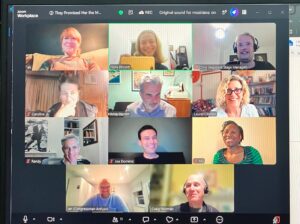
There have been so many joys working on They Promised Her the Moon, as well as the inevitable challenges. It’s been wonderful working with such an amazing cast and crew who have shared my enthusiasm in bringing this story to life. One of the unexpected bonuses was being contacted by playwright Laurel Ollstein, who was genuinely thrilled at the prospect of her show being produced in London (though I did have to remind her that West Norwood is not the West End!) At her suggestion, she joined the cast on a Zoom call from Los Angeles to share the research she had undertaken before writing the script – including interviewing some of the Mercury 13 – and answering our questions about the characters and their relationships. For all of us, meeting Laurel was “wow”, “fascinating” and “incredible”.
Working with a true story is a joy because there is so much available information: books, archive material, radio programmes, even a Netflix documentary. I don’t think I’ve ever been involved in a play where almost every character has their own Wikipedia page! But the challenge comes for both director and actors when you need to put the research and background reading aside, and work with the characters as they are in the script.
Describe the show in three words.
Flying. Dreaming. Believing.
They Promised Her the Moon plays 3 – 7 November 2026 at SLT Fire Station.